Temporary Operator’s Permit Philippines: TOP Validity Guide
A Temporary Operator’s Permit Philippines (TOP) is an official document issued to a driver when their license is confiscated due to a traffic violation. It serves as a short-term driving authority while the violation is being processed and settled with the Land Transportation Office (LTO).
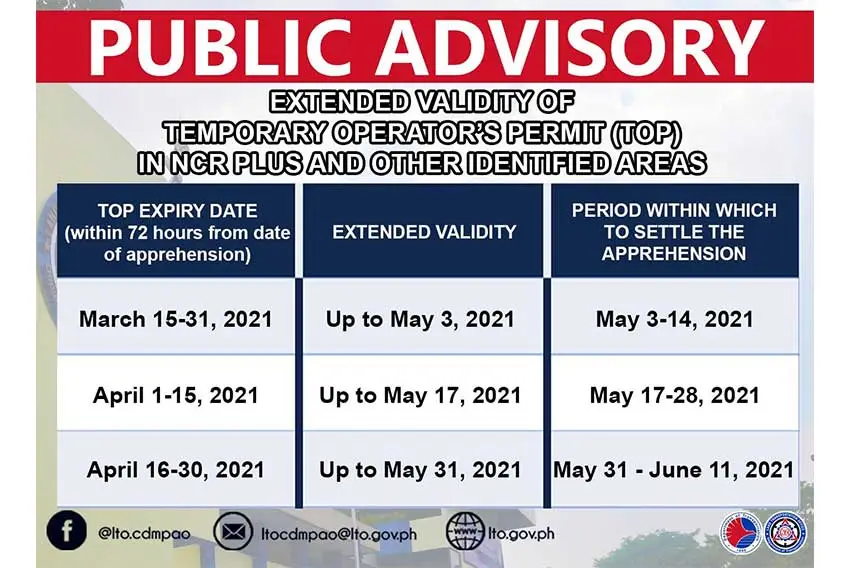
A TOP may be used as a temporary driver’s license for 72 hours, or three days, from the exact date and time it is issued. After that period, it can no longer be used legally for driving.
Many drivers receive a TOP but do not fully understand what it means, how long it is valid, where to settle the violation, or what happens after it expires. This guide explains everything in simple terms, including manual TOP, electronic TOP or e-TOP, the 72-hour rule, penalties, settlement steps, and the LTO’s digital ticketing system.
What Is a Temporary Operator’s Permit Philippines?
A Temporary Operator’s Permit Philippines is a citation ticket issued by the Land Transportation Office or its deputized agents when a driver is apprehended for violating traffic laws, rules, or regulations.
It is issued when the driver’s physical license is confiscated. The TOP then serves as:
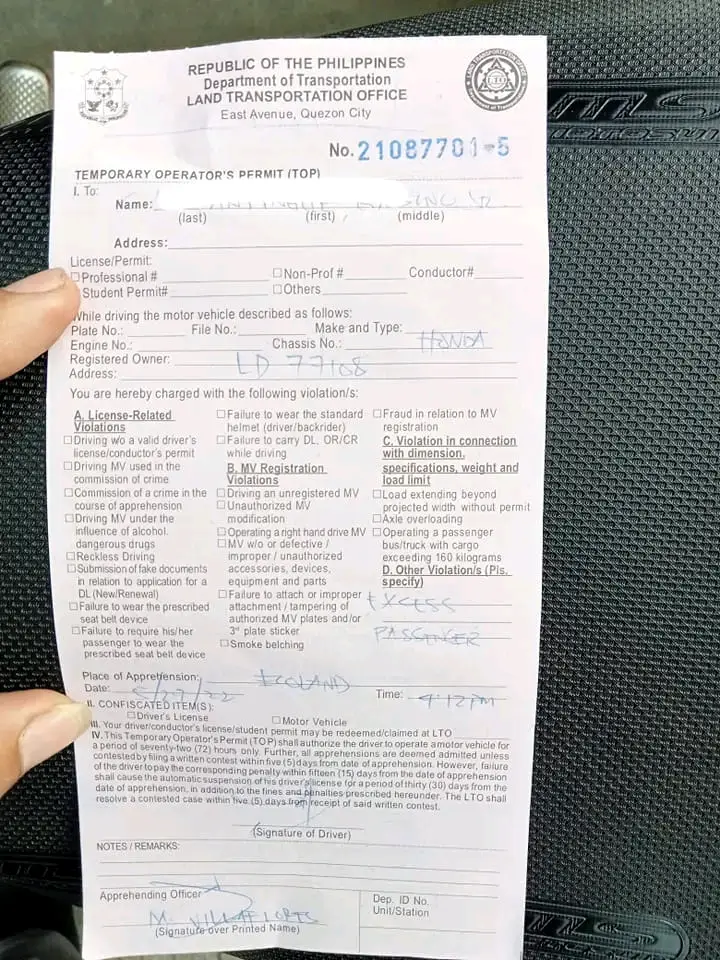
The TOP usually contains important information such as:
In simple words, the TOP allows an apprehended driver to keep driving for a limited time while they fix the violation and claim their license back.
How Many Hours May a Temporary Operator’s Permit Be Used as a Temporary Driver’s License?
A Temporary Operator’s Permit Philippines may be used as a temporary driver’s license for 72 hours, or three days, from the exact time it was issued.
This means the 72-hour count starts from the date and time written on the TOP. It does not start the next day.
For example, if your TOP was issued at 10:00 AM on Monday, it is valid only until 10:00 AM on Thursday.
Once the 72 hours are over, the TOP is no longer valid for driving. If you continue driving after it expires, you may be treated as driving without a valid license.
Does the 72-Hour Validity Include Weekends and Holidays?
Yes. The 72-hour validity runs continuously.
Weekends, holidays, or office closures do not automatically extend the validity of the TOP unless there is a specific instruction written on the permit or given by the LTO.
The safest rule is simple: follow the exact date and time written on your TOP.
Legal Basis of the Temporary Operator’s Permit Philippines
The use of a Temporary Operator’s Permit Philippines is connected with Philippine traffic and land transportation rules, including Republic Act No. 4136, also known as the Land Transportation and Traffic Code.
The TOP is also connected with LTO rules and guidelines on apprehension, traffic violations, and license confiscation. LTO Memorandum Circular No. 515-2004 also discusses the issuance of TOP, Impounding Receipt of Motor Vehicle, and LTO accountable forms during traffic apprehensions.
The purpose of issuing a TOP is to create an immediate record of the offense at the exact time and location of apprehension.
When Is a TOP Issued?
A Temporary Operator’s Permit Philippines is issued when a driver is apprehended for a traffic violation and the license is confiscated by the LTO or an authorized deputized agent.
Common reasons may include:
When this happens, the officer or deputized agent keeps the driver’s license and issues a TOP so the driver can still drive temporarily while the case is being processed.
Purpose of the 72-Hour TOP Rule
What Is the LTO Exam?
The 72-hour rule gives the driver enough time to settle the violation, pay the fine, attend a hearing if needed, or complete license-related matters.
It is not meant to allow unlimited driving after a violation. It is a short window given to the driver to act responsibly.
The rule helps:
If TOPs had no time limit, many drivers might delay settlement or continue driving without fixing their violation.
Can TOP Be Used as a Temporary Driver’s License?
Yes. A TOP can be used as a temporary driver’s license, but only during its validity period.
The permit allows the apprehended driver or operator to continue driving legally for up to 72 hours.
However, it is important to understand that a TOP is not the same as a regular driver’s license. It is temporary, limited, and connected to a traffic violation.
Once it expires, it cannot be used as a legal driving document.
Rights and Limitations of a Driver With a TOP
A TOP gives a driver temporary permission to drive, but it also comes with strict rules and limitations.
What You Can Do With a TOP
What You Cannot Do With a TOP
What Happens When a TOP Expires and Its Penalties
When a TOP expires, the driver is no longer allowed to drive using that permit.
Driving after the TOP expires may be considered driving without a valid license under LTO rules.
This can lead to more serious consequences than the original violation.
Possible consequences include:
Some cases may also involve a fine (commonly around ₱3,000) depending on the violation and updated LTO regulations. However, exact penalties may vary based on the situation and must be confirmed with the LTO office handling the case.
Many drivers mistakenly believe that an expired TOP still allows driving, but this is incorrect. Once the 72-hour validity ends, the Temporary Operator’s Permit automatically loses its authority.
Difference Between TOP Validity and Settlement Period
A common mistake is thinking that the 15-day settlement period means the driver can also drive for 15 days.
That is not correct.
The TOP is valid for driving for only 72 hours or three days.
However, apprehended drivers may be given a separate period to settle the violation, such as 15 days from the date of apprehension.
Here is the difference:
| Item | Meaning |
|---|---|
| 72-hour TOP validity | The time you are allowed to drive using the TOP |
| Settlement period | The time given to settle the violation, pay the fine, attend a hearing, or complete the required process |
| After 72 hours | You should not drive using the TOP anymore |
| Failure to settle on time | May lead to suspension, additional fines, or other LTO penalties |
Some LTO references mention that failure to settle within the required period may result in automatic license suspension for 30 days, in addition to fines and penalties.
How to Settle a Violation After Receiving a TOP
Once you receive a TOP, settle the violation as soon as possible.
Follow these steps:
It is better to settle early instead of waiting until the last day. This helps avoid long lines, missed deadlines, extra penalties, and problems with your license record.
Can You Contest a TOP Violation?
Yes, a driver may contest a violation if they believe the apprehension was incorrect or unfair.
To do this, the driver should go to the proper LTO office or the office listed on the TOP and follow the required procedure. Some cases may require a hearing or formal explanation.
Do not ignore the TOP just because you plan to contest it. You still need to follow the correct process and appear within the required period.
Difference Between a Driver’s License and a Temporary Operator’s Permit Philippines
Both a driver’s license and a TOP may allow a person to drive, but they are not the same.
| Aspect | Driver’s License | Temporary Operator’s Permit Philippines |
|---|---|---|
| Issued by | LTO after passing requirements and completing the application process | LTO or deputized agent after a traffic violation |
| Main purpose | Gives full legal permission to drive | Allows temporary driving while a violation is being settled |
| Validity | Usually 5 or 10 years, depending on eligibility and rules | 72 hours or three days |
| Status | Regular, active driving credential | Temporary and limited |
| Reason for issuance | Normal licensing process | License confiscation due to traffic violation |
| Use as ID | Commonly accepted as a valid ID | Not meant to be used as a general ID |
| Driver obligation | Follow traffic laws and renew on time | Settle the violation and retrieve the license |
In short, a driver’s license is your long-term legal authority to drive. A TOP is only a short-term document issued after a violation.
Manual Temporary Operator’s Permit Philippines
A manual TOP is the traditional paper-based citation ticket issued by an LTO-deputized traffic enforcer.
It is usually written by hand using a physical booklet. The booklet has four copies, and the driver normally receives the pink copy.
A manual TOP is sometimes called a pink slip because the copy given to the driver is often pink.
Copies of a Manual TOP
A manual TOP is usually prepared in four copies.
Original Copy
The original copy is attached to the daily apprehension report by the apprehending officer. It may be submitted to the proper LTO office, sectoral office, operations division, regional office, or other assigned unit for encoding and processing.
Second or Pink Copy
The pink copy is given to the apprehended driver or operator. This is the copy the driver carries while driving during the 72-hour validity period. It is also presented when settling the violation and redeeming the license.
Third or Yellow Copy
The yellow copy is kept by the apprehending officer for record purposes.
Fourth or Blue Copy
The blue copy is submitted for audit or official record purposes, such as to the COA Resident Auditor, depending on the required process.
Electronic Temporary Operator’s Permit Philippines
An Electronic Temporary Operator’s Permit Philippines, also called e-TOP, is the digital version of the TOP.
It is generated through an officially issued law enforcement handheld mobile device. Instead of writing the citation by hand, the enforcer uses a device to record the violation and print a machine-generated ticket.
The e-TOP is used for roadside inspection, field apprehension, and enforcement operations involving violations of traffic and transportation laws.
It serves the same purpose as the manual TOP:
The difference is that the e-TOP records the violation digitally and helps connect the information with the LTO’s online database.
Manual TOP vs Electronic TOP
The Temporary Operator’s Permit Philippines can be issued in two formats: manual TOP and electronic TOP (e-TOP). Both serve the same purpose but differ in processing method and system usage.
| Feature | Manual TOP | Electronic TOP (e-TOP) |
|---|---|---|
| Issuance method | Handwritten using a four-copy booklet | Issued through a handheld electronic device that prints a ticket |
| Driver copy | Pink paper copy | Printed electronic receipt |
| Data recording | Manually written and encoded later | Digitally recorded in real time |
| Processing time | Around 15–20 minutes | Around 5–10 minutes |
| License verification | Manual checking | May include scanning, camera, or biometric tools |
| Payment process | Usually paid at LTO office or authorized centers | May support cashless or digital payment systems |
| Convenience | More paperwork and manual steps | Faster and more efficient process |
| Transparency | Higher risk of manual handling issues | Reduced risk through digital tracking |
| Connectivity | Does not require internet | Can store offline data and sync later |
| Main use | Traditional enforcement system | Modern digital enforcement system |
Why LTO Is Moving Toward e-TOP
The LTO has been moving toward digital traffic violation processing to make enforcement faster, cleaner, and more transparent.
The e-TOP system helps:
The goal is to create a safer, more efficient, and more reliable traffic violation management system.
LTO Mobile Devices for Digital Violation Tickets
The LTO has introduced law enforcement handheld mobile devices for issuing digital violation tickets and electronic Temporary Operator’s Permit Philippines.
These devices are used by authorized LTO law enforcement officers to generate e-TOP tickets during apprehension.
The handheld device can help:
Once a violation is recorded in the device, it becomes harder to alter or interfere with the record.
No More Manual Temporary Operator’s Permit Philippines
With the digital system, LTO traffic enforcers can issue machine-generated e-TOP tickets instead of handwritten manual TOPs.
This does not mean manual TOPs disappear completely in every situation. Manual TOPs may still be used as backup when the digital system cannot be used.
However, the direction of the LTO is clear: more digital records, more automated processing, and less dependence on handwritten tickets.
Features of LTO Law Enforcement Handheld Mobile Devices
Law enforcement handheld mobile devices may include features such as:
These features help enforcers verify whether the license presented is genuine and make the apprehension process more reliable.
Can e-TOP Work Without Internet?
Yes, the handheld device may still issue a violation ticket even if there is no internet connection at the moment.
The device can store the transaction temporarily. Once mobile data or internet connection becomes available, the transaction can be uploaded to the LTO system servers.
Some devices may use mobile data SIM cards to connect with the system. This helps keep enforcement active even in areas with weak signal or temporary connectivity problems.
Cashless Payment and Digital Settlement
Part of the digitalization effort is to support easier payment options for traffic violations.
Electronic payment channels may include options such as:
Payment options may vary depending on the LTO system, location, and current implementation. Drivers should always follow the instructions shown on their TOP, e-TOP, or LTMS account.
Digitalization and TOP Under LTMS
The Land Transportation Management System, or LTMS, helps organize driver records, violations, and transactions online.
Through digital systems connected with LTO services, drivers may be able to:
The LTMS helps reduce long lines, improve record accuracy, and make transactions easier for motorists.
When Is Manual TOP Still Used?
Manual TOP may still be used when the electronic system cannot be used.
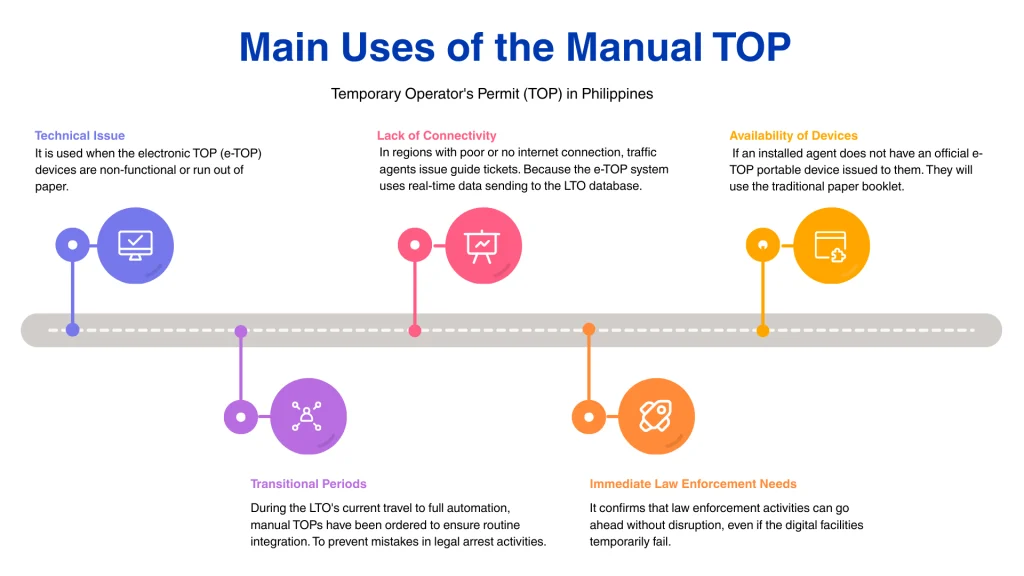
Common situations include:
Technical Issues
Manual TOP may be used when the e-TOP device is not working, has a technical failure, or cannot print the ticket properly.
Lack of Internet or Data Connection
Manual TOP may be used in places with no internet, weak signal, or intermittent mobile data connection.
Unavailable Handheld Device
If the apprehending officer does not have an officially issued handheld mobile device, a manual TOP may be used.
Transitional Period
During the rollout or adjustment period of the LTMS and e-TOP system, manual TOPs may still be used to keep enforcement operations running.
Immediate Law Enforcement Needs
Manual TOP can be used so traffic enforcement does not stop when digital equipment temporarily fails.
Other Rollout Circumstances
Other situations may arise during system implementation where a manual TOP is necessary.
In these cases, the manual TOP functions the same way as the e-TOP. It is still valid for only 72 hours as temporary authority to drive.
Who Can Issue a TOP or e-TOP?
A TOP or e-TOP may be issued by authorized LTO officers and deputized agents.
These may include authorized personnel from:
Regular traffic enforcers may apprehend drivers depending on their authority, but license confiscation and TOP issuance should follow LTO rules and authorized procedures.
Can a Traffic Enforcer Confiscate a Driver’s License?
Traffic enforcement authority may depend on the agency, deputation, and legal basis.
Under LTO-related rules, license confiscation and TOP issuance are generally connected with LTO officers and authorized deputized agents.
If your license is confiscated, make sure you receive the proper TOP or e-TOP as your proof and temporary driving authority.
TOP, IRMV, and LTO Accountable Forms
LTO Memorandum Circular No. 515-2004 mentions the issuance of TOP and other accountable forms during apprehension.
These may include:
These forms help create an official record of the violation, apprehension, or vehicle-related enforcement action at the exact time and place of the incident.
Exceptions and Clarifications About the 72-Hour Rule
The safest rule is that a TOP is valid for 72 hours only.
However, some situations may require clarification from the LTO or the office handling the case, such as:
Unless there is a clear written instruction, drivers should not assume that the TOP validity is extended. Always follow the time printed on the TOP or confirm directly with the LTO.
Tips for Drivers With a TOP
If you receive a TOP, follow these tips:
What to Do If You Lose Your TOP
If you lose your TOP, contact the LTO office or the office where the violation is being handled as soon as possible.
You may need to provide:
Do not ignore the violation just because you lost the TOP. The violation may still be recorded in the LTO system.
Responsible Driving After Receiving a TOP
A TOP is not only a ticket. It is also a reminder that road rules matter.
After receiving one, a driver should:
Being a responsible driver does not mean never making mistakes. It means correcting them properly and avoiding the same mistake again.
Frequently Asked Questions
Final Thoughts
A Temporary Operator’s Permit Philippines is a short-term driving authorization issued after a traffic violation. It gives the driver time to settle the case and retrieve the confiscated license, but it is not a permanent replacement for a driver’s license.
The key rule is simple: a TOP or e-TOP may be used as a temporary driver’s license for 72 hours only. Settle the violation early, keep your documents safe, follow LTO instructions, and avoid driving once the permit expires.
The TOP system, especially with digital e-TOP, is designed to make enforcement more organized, transparent, and responsible for both drivers and the LTO.